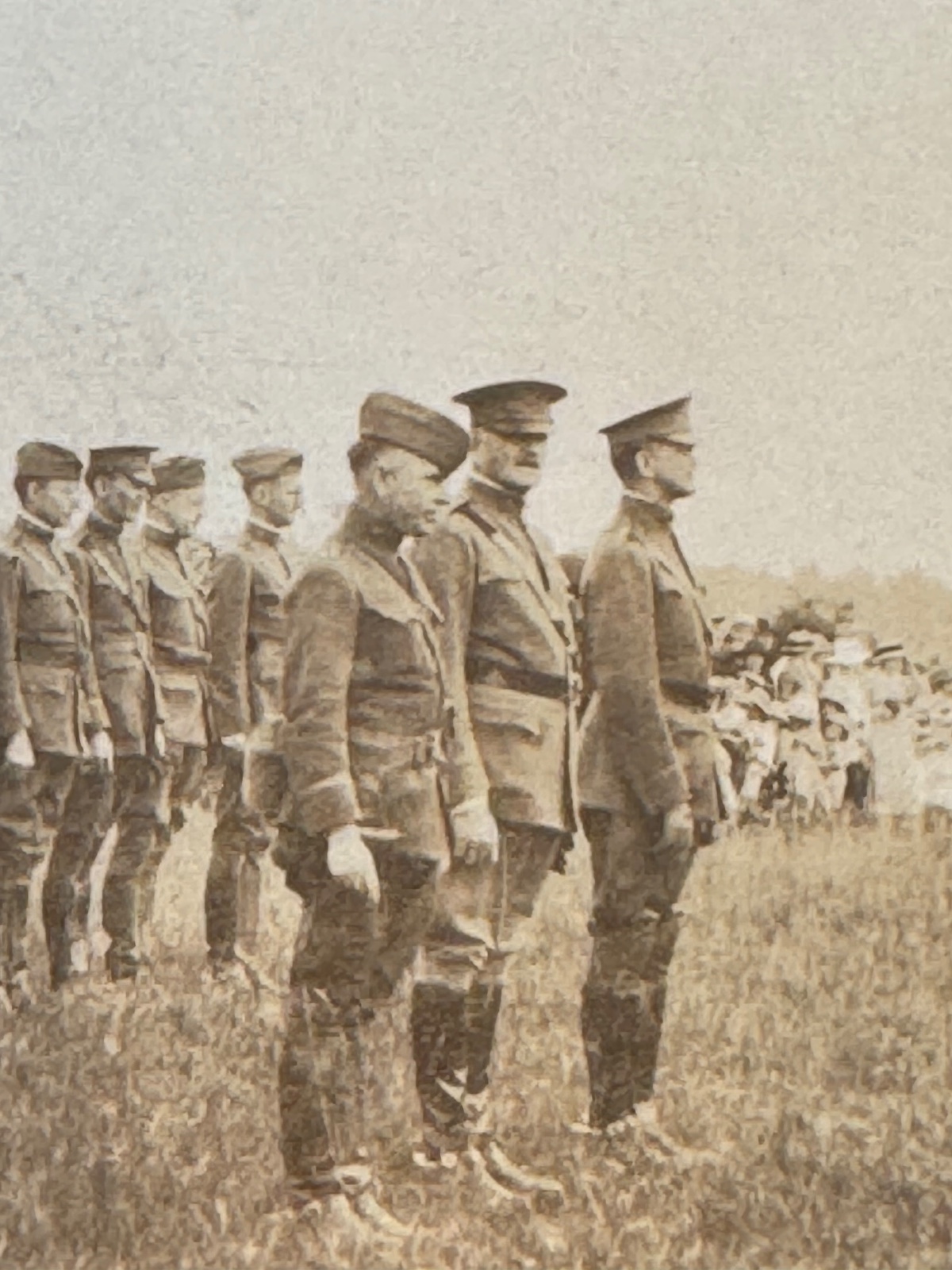
17 RPPC Archive of General John “Black Jack” Pershing Reviewing Troops at Camp Pershing OH
$500.00
Original period item
- Type
- Photograph · Postcard
- Subjects
- Military
- Era
- 1910s
- Shipping
- $0.00 first item, $0.00 each additional
17 Original Real Photo Postcards from Camp Sherman, Ohio, from the Collection of Claude Wyeth Some collections arrive as a stack of images. This one arrives as a story. Here are seventeen original real photo postcards from Camp Sherman in Chillicothe, Ohio, one of the great training grounds of America's World War I army. They were kept together for more than a century by the man who was there, Claude Wyeth, and he appears in one of them. A Camp Built for a War When the United States entered the Great War in April 1917, it had a small standing army and an urgent need for a large one. The War Department responded by building cantonments across the country, entire military cities raised in a matter of months. Camp Sherman, named for Ohio's own General William Tecumseh Sherman, rose on farmland just outside Chillicothe in the summer of 1917. Within weeks it held barracks, mess halls, drill fields, hospitals, and rail sidings, and soon it held tens of thousands of draftees from Ohio and neighboring states. These young men arrived as farmhands, factory workers, clerks, and students. At Camp Sherman they learned to march, to shoot, to dig, and to move as one body under command. Many went on to serve in France with the 83rd Division and other units. Some never came home. The camp itself would be struck hard by the influenza pandemic of 1918, a tragedy that still marks its history. Today almost nothing of Camp Sherman remains standing. Much of the ground is now part of Hopewell Culture National Historical Park, and the rest is occupied by a VA medical center and other institutions. Photographs like these are among the few surviving windows into what the camp looked like and what life there felt like. The Review The centerpiece of this lot is a review. As captioned, these cards show General John J. Pershing reviewing troops at Camp Sherman in 1917. Formal reviews were among the most important events in a soldier's training. Whole regiments assembled in precise formation, uniforms brushed, rifles aligned, while senior officers passed along the lines and inspected the results of months of drilling. For the men in the ranks, a review was proof that they had become soldiers. For the photographers who worked the camps, it was the ideal subject: massed formations, flags, mounted officers, and the sweep of an army on parade. The images in this lot capture that scale. Long ranks of soldiers stretch across the drill grounds, officers and the reviewing party move along the lines, and the camp itself fills in the background. Together, the seventeen cards work almost like a short film of the event, giving a sense of sequence and movement that a single card cannot. Claude Wyeth: The Man Behind the Collection What elevates this lot from a fine group of military RPPCs to a true historical archive is its provenance. These cards come from the collection of Claude Wyeth, who appears to have served at Camp Sherman during the war. He saved them, kept them together, and carried them out of the war and through the decades that followed. Better still, Claude Wyeth himself appears in one of the postsle cards. It is one thing to own a photograph of history. It is another to own the photograph a soldier kept because he was in it. That personal link turns a group of scenes into one man's record of the most significant days of his young life. Collections that remain intact with a known soldier's provenance are increasingly hard to find. Over the years, most such groups were broken up, sold card by card, or lost entirely. This one survived whole. Real Photo Postcards: Why They Matter Real photo postcards were not printed reproductions. Each was a genuine photograph, developed directly onto postcard-backed photographic paper. That gives RPPCs a sharpness, tonal depth, and detail that printed cards of the era cannot match. Under magnification, you can often read insignia, count buttons, and study faces in a crowd. Fifteen cards in this lot are on AZO stock, the most widely used real photo postcard paper of the era and a favorite of camp photographers. The AZO stamp box is a hallmark of authentic period RPPCs, and its design variations are a trusted tool collectors use to date cards. During World War I, RPPCs were the social media of the training camps. Soldiers bought them by the handful to mail home, to trade, and to keep as souvenirs. Camp photographers produced them in modest runs, so many views survive in only a few examples, and some in just one. A large, coherent group from a single camp and a single event is uncommon. A group with a named soldier attached is rarer still. Details of the Lot This lot includes 17 original real photo postcards, 15 on AZO stock, all from Camp Sherman, and all from the collection of Claude Wyeth. Condition is consistent with age and honest period use. Please review all photos carefully, as they are part of the description. This lot will appeal to collectors of World War I militaria, Ohio history, real photo postcards, and American military photography. It would make an outstanding addition to a museum, historical society, or research collection focused on the American home front and the mobilization of 1917–1918. It is also a natural fit for anyone researching Camp Sherman, the 83rd Division, or the Chillicothe area during the war.