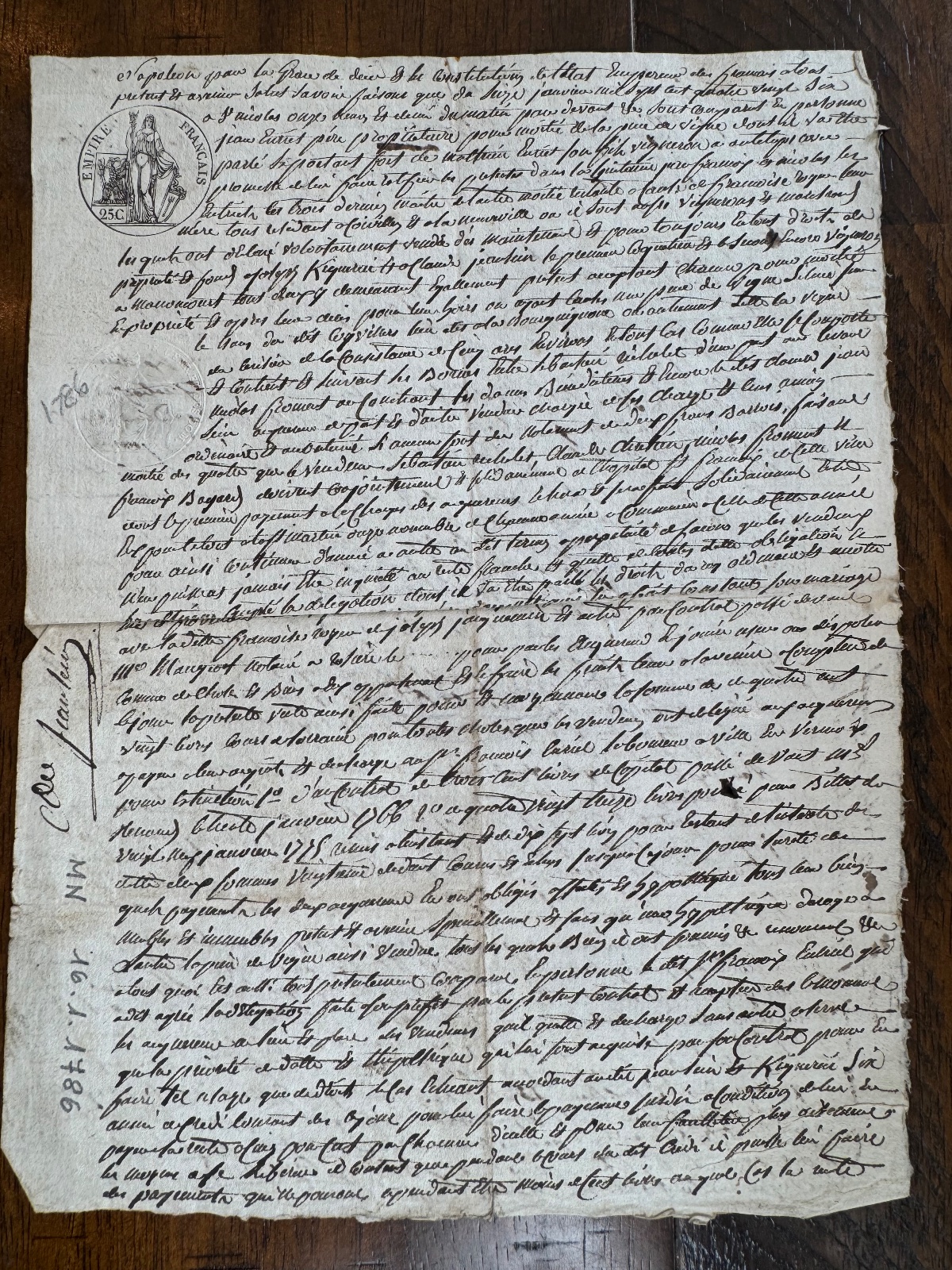
1806 Napoleonic Notary Deed For Vineyard Referncing Napoleon
$375.00
Original period item
- Type
- Document · Letter
This is a French notarial deed from Napoleon's First Empire, most likely dated 16 January 1806, recording the sale of a vineyard plot between rural families. How it's dated • The opening line is the standard imperial formula: "Napoléon, par la grâce de Dieu et les Constitutions de l'État, Empereur des Français, à tous présents et à venir, salut…" That wording was only used from 1804 to 1814. • The printed stamp reads "Empire Français, 25 c." It is a tax stamp of the Napoleonic era. Paper had to carry one to be valid for legal documents. • The date line looks like "le seize janvier mil huit cent six" (16 January 1806), "around half past eleven in the morning." • The pencil marks "1786" and "16.1.1786" were added later, probably by a dealer, and are almost certainly a misreading. A 1786 document couldn't carry an "Empire Français" stamp. The earlier dates you can see in the text (1766, 1775) refer to older contracts, not to this deed. What it says (gist; the handwriting is rough in places) • Before a notary, a landowner (something like Jean Eutret, père) appears. He acts for himself and stands surety for his son Mathieu, a vigneron (winegrower). Other family members, including a Françoise, sell a pièce de vigne, a plot of vineyard, held in shares ("pour moitié," the three-quarters, etc.). • The buyers are other local vignerons. They accept the sale for themselves, their heirs, and assigns. • The rest is typical sale language: • boundaries of the plot by its neighbors • the price and how it's paid • the buyers taking on the sellers' old debts, expressed in livres (pre-Revolution money) and tied to a marriage contract and earlier deeds from 1766 and 1775 • a general mortgage on all their goods, movable and immovable, present and future ("affectent et hypothèquent tous leurs biens meubles et immeubles présents et à venir") as security • The vertical signature in the margin is likely the clerk's or notary's. "Mangeot" appears to be named as a notary in the text.